Provider evaluation matrix
Compare trial, playback, content, devices, limits, payment, renewal, privacy, and support.
Comparing IPTV service providers should reduce uncertainty, not replace it with a bigger marketing claim. A useful review examines whether a trial exists, how the service behaves on your actual device and network, how content availability is described, what the connection limits mean, how payment and renewal work, and whether support protects private access. This guide provides a reusable framework and then explains where IPTV FREE TRIAL fits without declaring itself universally best.
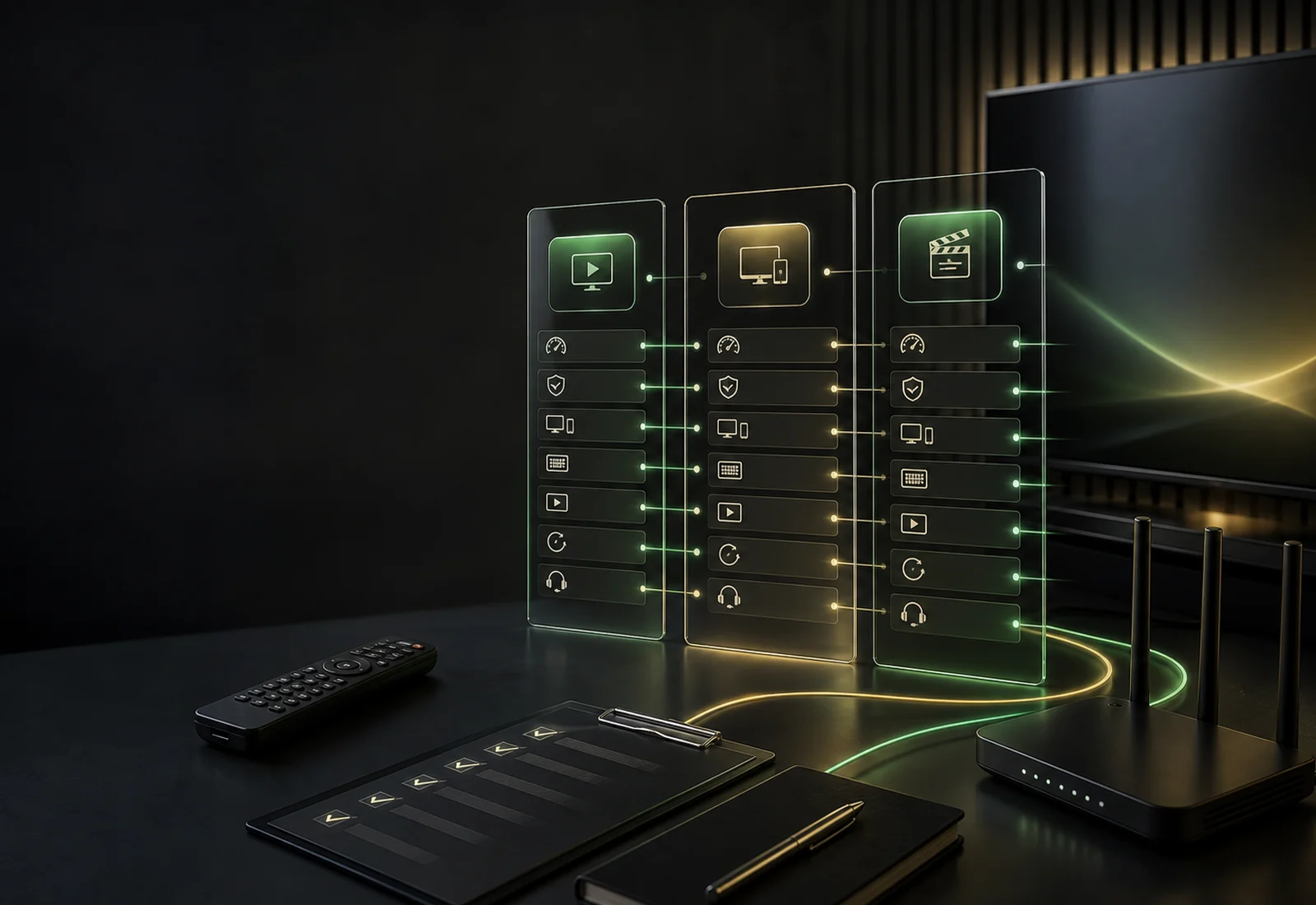
Compare trial, playback, content, devices, limits, payment, renewal, privacy, and support.
Record tested, concern, or not tested rather than turning an unknown into a promise.
Test first, review public terms and plan limits, then choose only when the evidence fits.
A trial is useful only when its duration, delivery, limits, and purpose are clear.
Write down the primary device, priority channel or category, preferred language, expected simultaneous screens, and normal viewing time. Use the trial to inspect login, navigation, live startup, sustained playback, on-demand browsing, EPG where available, and support response. A trial that requires unrelated payment data or hides its duration deserves caution.
Keep the trial credentials private and note safe evidence. A single successful minute is not proof of long-term performance, while one source interruption is not proof that every category fails. Repeat controlled checks.
Stability is a result of the source-to-screen path, not one universal percentage.
Use the intended device, official player, household network, and typical viewing time. Compare Wi-Fi with Ethernet when practical and test more than one enabled source. Record startup, sustained playback, audio synchronization, and recovery behavior.
Be cautious with unsupported uptime guarantees. The source, provider systems, network route, household traffic, Wi-Fi, player, decoder, and display all influence playback. A responsible provider should help separate those factors.

A long device logo list is less useful than an accurate guide for your operating system.
Confirm the provider explains Smart TV, Firestick, Android TV, iPhone, and computer paths where relevant. Guides should distinguish M3U from server, username, and password fields, explain that third-party player licences are separate, and avoid unknown modified apps.
Support should accept safe information such as device model, player, time, network, and error text without asking customers to publish credentials.
Features may depend on the supplied source and how the player presents it.
For EPG, check timezone, refresh, category matching, and completeness where available. For VOD, inspect search, categories, season order, language indicators, favorites, and resume behavior. For catch-up, confirm whether the specific source and player support it; do not assume it applies to every live channel.
No provider should use a screenshot or poster as permanent evidence that every title, programme, or channel remains available. Ask about must-have content specifically.
Providers often use similar words for two different limits.
Installable devices describe how many approved devices may hold the setup. Simultaneous streams describe how many playback sessions may run at once. Compare the exact published values and ask what happens when a device is replaced.
Avoid providers that encourage uncontrolled credential sharing. It weakens privacy, can exceed connection limits, and makes support harder. Test the realistic household combination within the offered allowance.
The total, method, evidence, confirmation, and activation sequence should be visible before money moves.
The provider should show the selected duration, streams, devices, total, currency, and available payment method. Bank details and payment references are sensitive and should not be exposed on generic public pages. A receipt upload should be validated and stored privately.
Submitting proof is not the same as confirming payment. A trustworthy process records review, then activates and delivers access only after authoritative confirmation. Avoid requests for a bank login, card secret, private key, or payment through an unrelated personal chat.
A subscription decision includes what happens at the end of the period.
Find the duration, expiry behavior, renewal method, reminder process, and whether the service renews automatically. A provider should not create urgency with an unverified countdown or hide a recurring commitment in a separate message.
The IPTV FREE TRIAL experience does not renew automatically or create a paid order. Paid renewal follows the published private order process rather than silently charging through an unconfigured gateway.
Fast wording is not the same as useful resolution.
Request a channel check, clarify a device login method, or ask how simultaneous streams work. Evaluate whether the answer is specific, honest about uncertainty, and protective of private data. Keep a record of the policy or plan details used in the decision.
During troubleshooting, the provider should help isolate the source, device, app, and network. It should not need your full playlist or password in a public support conversation.
Unsupported certainty and weakened security are not customer benefits.
Be cautious with guaranteed universal uptime, permanent channel or title counts, every-event promises, fake testimonials, invented customer totals, or pressure based on a timer that resets. Do not install unknown applications, disable device protections without a documented need, or send identity and payment data through an untrusted route.
A copied competitor page or hardware-encoder keyword page does not demonstrate a customer subscription service. Evaluate the real journey, policies, and device guidance.
IPTV FREE TRIAL is one available option and should be tested against the same criteria.
IPTV FREE TRIAL provides a separate 24-hour trial request, device and setup guides, specific content-availability requests, live plan records with separate stream and installable-device limits, a private manual-payment review flow, customer order status, and support routes. Content and quality are described with source and availability context rather than guaranteed totals.
The appropriate decision depends on your device, location, network, content priorities, budget, and support needs. Start the trial, record the result, read the plan and renewal information, and choose only when the evidence fits.
A short written comparison prevents one flashy claim from dominating the decision.
Score trial clarity, sustained playback, required content, device support, installation guidance, EPG, VOD, catch-up where relevant, simultaneous streams, payment transparency, renewal, privacy, and support. Mark anything you did not test rather than assuming it works.
Keep private credentials and payment information out of the scorecard. Save only customer-safe observations and the public policy or plan links used.
These answers explain the current customer journey without turning variable content or playback conditions into guarantees.
Use the same device, network, viewing time, content priorities, and written criteria for each legitimate service. Record what was tested and what remains unknown.
Trial availability is one useful signal, but the duration, limits, privacy, and delivery process also matter. Do not provide unnecessary payment or identity data for a simple test.
Ask for the exact channel, event, region, and language, then compare the answer with the current trial. Treat it as a point-in-time check.
The selected plan, total, currency, method, reference, evidence process, review state, and activation sequence should be clear in a private order journey.
No universal best claim is made. IPTV FREE TRIAL should be evaluated using the same trial, device, content, payment, renewal, privacy, and support criteria.
Then compare the published plan, payment, support, and renewal journey before deciding.